
EXPANNIE 36
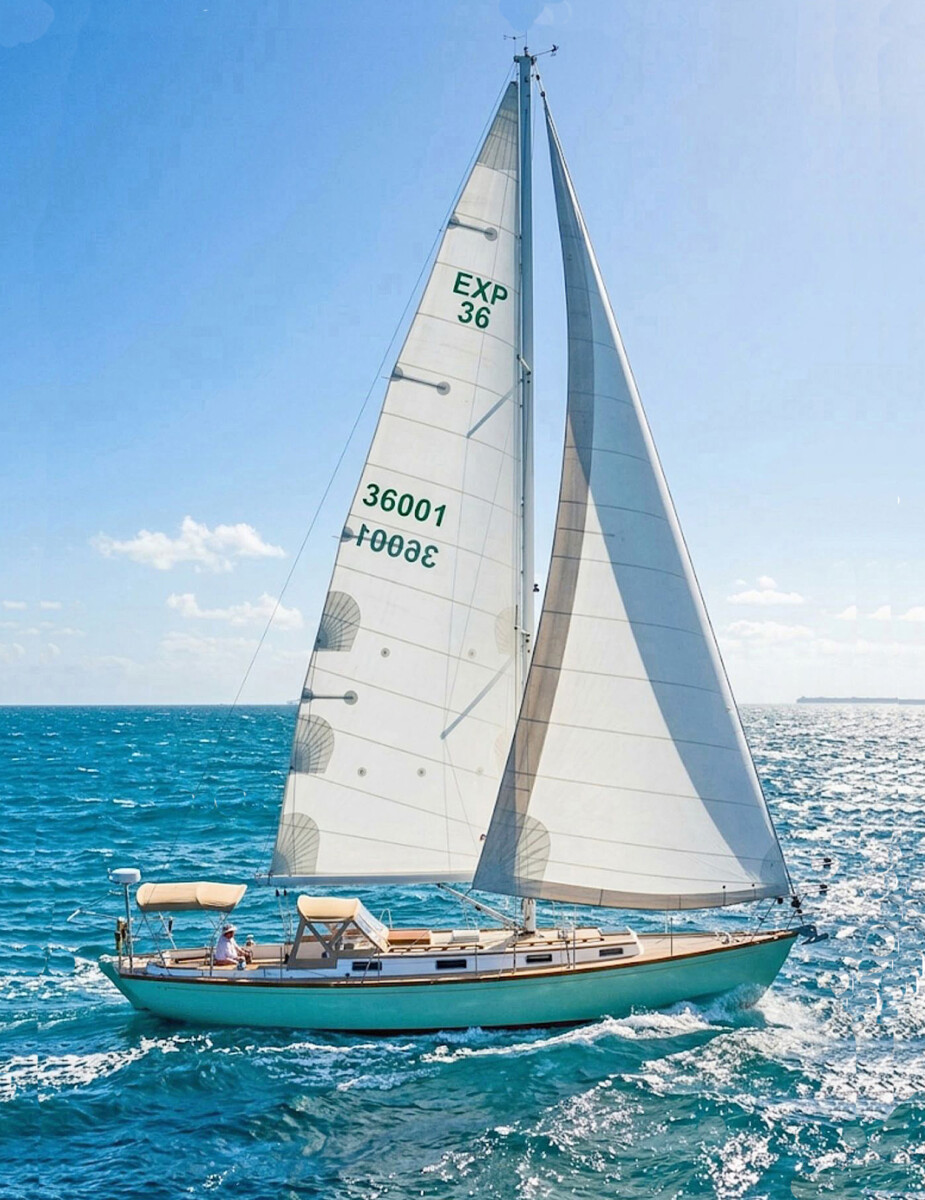
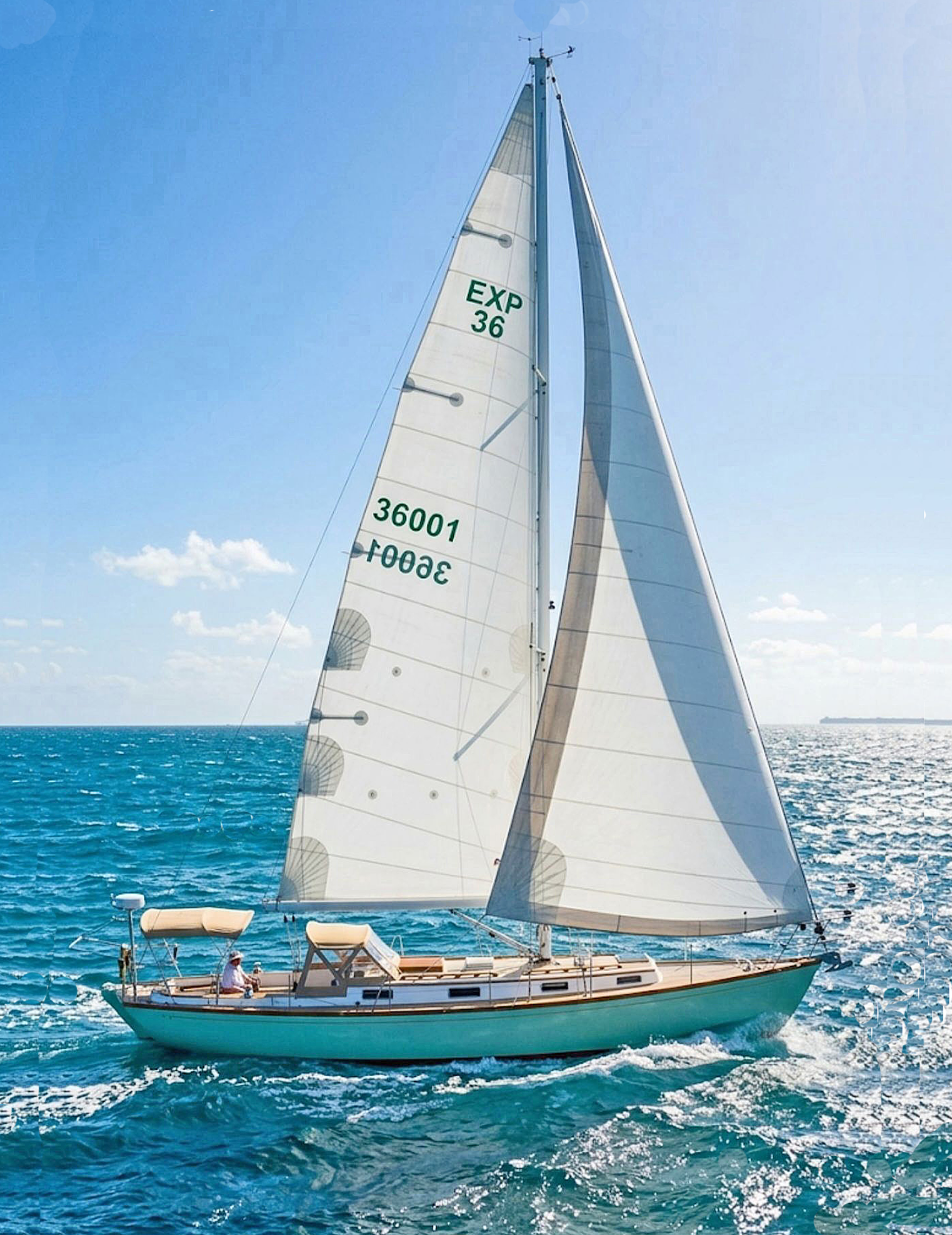
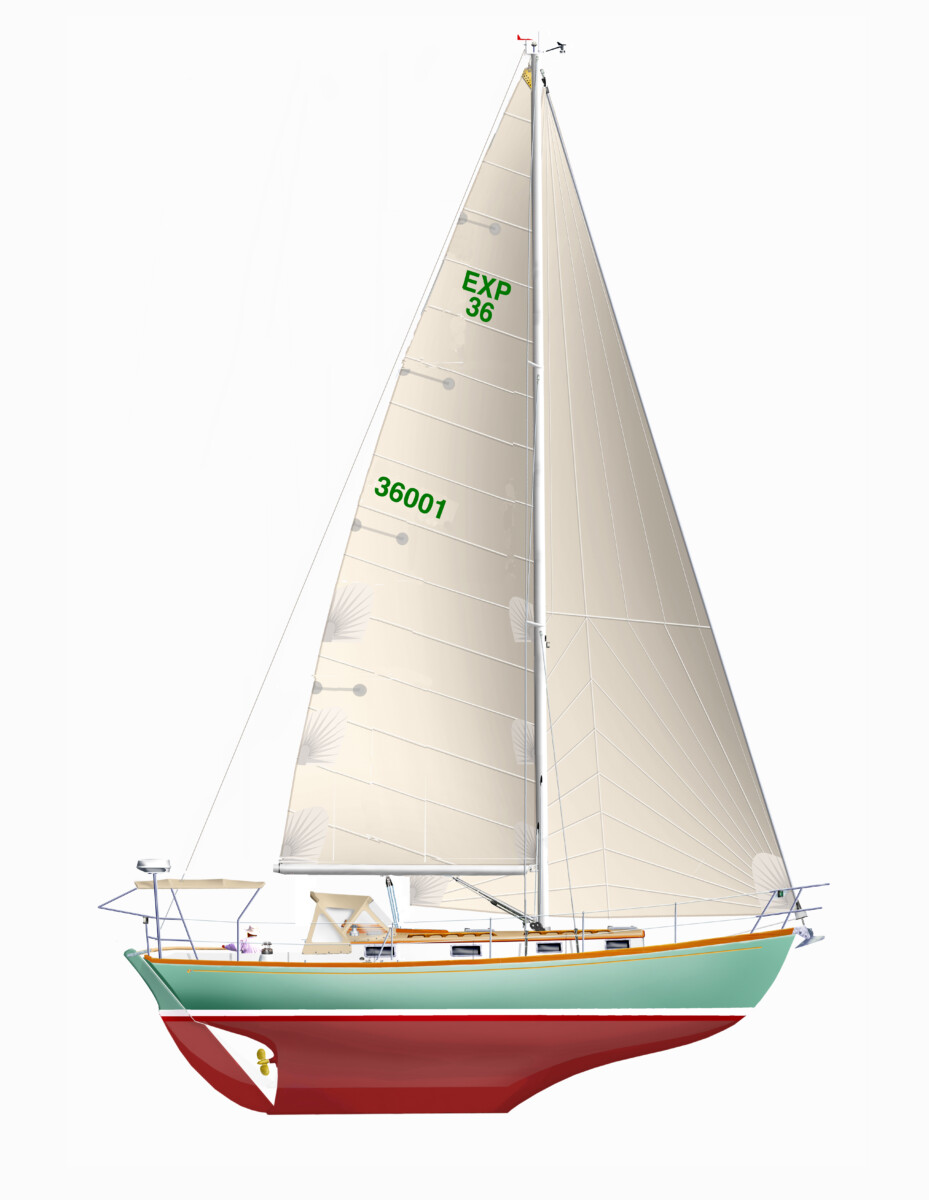
An AI generated rendering of the EXPANNIE 36. There are a few mistakes – the tiller is not shown emerging from the rudderhead and the stern metalwork/davits are not shown- but it gives a good indication of how the yacht will look. Credit: Steve Avery
LOA: 36′ 3″
LWL: 30′ 0″
BEAM (excluding guards): 11′ 8″
DRAFT, on DWL: 5′ 2″
DISP, 1/2 load: 18,170 lbs
BALLAST: 7268 lbs
SAIL AREA (100% fore triangle): 669 sq ft
SAIL AREA (IMS): 715 sq ft
SA/DISP: 17.5
SA/DISP (IMS): 18.70
DISP/L RATIO 250
EXPANNIE has everything- she is beautiful to look at, has a wonderfully easy motion at sea owing to her heavy displacement, is easily steered by her windvane self steerer thanks to her moderately long keel, and is fast in all but the lightest of airs. I know that heavy boats need not necessarily be slow— it is the ratio between propulsive force (sail area) and resistance (displacement and wetted surface) that counts. So a heavy boat can be plenty fast, if the sailplan is large enough. Please be advised – this is a design that is intended specifically for long term, long distance, open ocean voyaging. It is of sufficiently heavy displacement to accommodate the thousands of pounds of stores and keepsakes that accumulate aboard a yacht when it is a family’s home. It will be expensive to build but relatively cheap to maintain.
EXPANNIE is also extremely stable. Everyone knows that small boats whose decks stay reasonably level underfoot are far more pleasant to spend time aboard than ones that sail on their ear. A yacht that is intended for ocean voyaging should be at least 10 to 20% more stable than any yacht designed for inshore cruising or racing – the wind blows consistently harder in the middle of an ocean than it does along its shores.
This is my “end of the world” design… the sanctuary you will bolt to if your nearby city has been vaporized by a nuclear warhead or simply if the kids are grown up, you’ve come into a pile of money, and you want to see the watery part of the world. It will be fun to sail, beautiful, and capable of safely sailing to the tropical paradise of your choice. If fitted with new sails, with a recently cleaned bottom, it will even sail well enough to win races in the increasingly popular Classic Yacht classes, though this is not its primary mission. It will be built in WEST System cold molded construction, epoxy saturated and glassed over for extreme longevity, or heavy Vinylester based fiberglass composite.
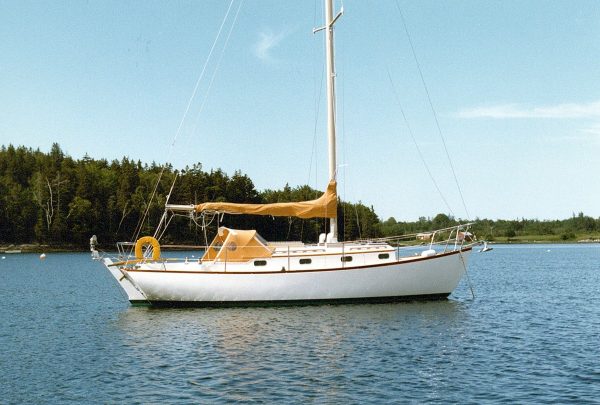
THE PROGENITOR—MY LITTLE “ANNIE” – ONE OF THE FASTEST AND MAYBE THE MOST STABLE 29 1/2 FOOTER EVER. SHE WAS BEAUTIFUL, CLOSE WINDED, AND COMFORTABLE.
It is an expansion of my 30’ ANNIE design, which I naturally named “EXPANNIE“. I was ready for a larger boat than 30 feet and so the question then became, by how much to scale her up and what, if anything, to change. Everything can be manually operated if the engine fails or the batteries go flat- the steering, hoisting and trimming of sails, anchor handling, docking, etc. The motor is used only for propulsion. Any convenience gadgets are small and easily replaceable.
The eventual choice of a little over 36 feet in length was arrived upon because no matter how many friends you have, there are times in long voyages and circumnavigations when the owner must move the yacht from one harbor to another singlehanded, and anything above this size can be downright dangerous to attempt to handle without a second pair of hands. These frightening occurrences usually happen when seeking to anchor in avoidance of impending weather, or when forced to depart an anchorage—invariably in the dark of night—when a change of wind puts one dangerously close to a lee shore. A yacht of EXPANNIE’s size is on the edge of being manageable by a single, strong person in these circumstances, while anything larger is not.
In EXPANNIE I attempted to preserve all of the wonderful characteristics of the smsller progenitor, and to solve the problems that ANNIE has suffered; too little headroom for tall people, and the difficulty of getting aboard her if I wanted to go swimming or fell overboard. The headroom was easy—just scale her up to 36 feet or so and the problem solved itself. Reboarding from a man-overboard scenario or swimming required some original thinking, which is what a designer loves to do.
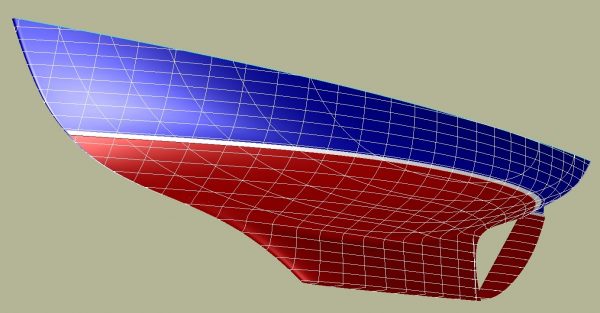
EXPANNIE’s keel is severely cut away forward, and additionally shortened by creating the huge aperture aft. Shortening the keel in this way increases its aspect ratio for better windward performance, significantly reduces the amount of wetted surface, and enables a partially balanced, almost spade-like rudder to be fitted. The bottom of the keel is almost level, and its forward “knuckle” is forward of the center of gravity of the vessel, so it can be safely dried out alongside a wharf or stored for long periods of time ashore as is the fate of yachts that are used for yearslong voyages around the world.
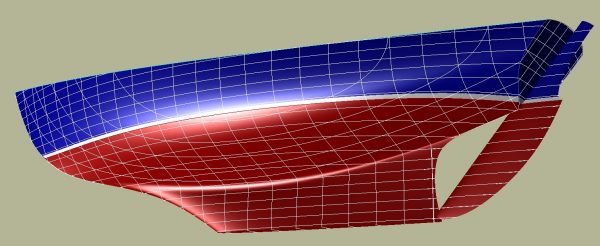
The aperture enables a portion of the rudder to be forward of its pivot axis, making it for all intents and purposes a spade rudder with an additional support at its lower end. Because the center of pressure of the rudder is only slightly aft of the pivot axis, very small helm forces are required no matter how much force the rudder is exerting- friendly to both human helmsmen (and women) and wind-powered self-steering devices and battery-powered autopilots.

Here is her latest accommodations plan. The starboard quarter area is a walk-in closet with huge amounts of storage space accessible from inside the boat—no deep sail locker on that side. At its front is a chart table where you sit on the new invention that no yachts should be without… a YETI or West Marine 12-volt freezer box. It is removable so you can take it home or by jitney to a nearby market to pack it with frozen food before each voyage. The aft end of the interior on the starboard side is arranged so that quick and comfortable access can be made to almost the entire engine and the drive shaft and stuffing box- no contortions at the bottom of a sail locker or with your head down in a hole to maintain the engine or fix a leaking shaft seal. The head is large and has an accompanying shower stall. If one wanted, one could carry aboard three lightweight foam mattress sections which could be made into a quarter berth by moving the YETI cooler elsewhere, and if this were done the yacht could sleep six persons.
EXPANNIE is a yacht designed according to the KISS principle, distinguishable from her contemporaries by what she does not have aboard as opposed to what she does. She is of a size to leave ashore electric winches, watermaker (she’ll have an easily valved rain catchment system), wind instruments (you were born with cheeks for this purpose), television (she’ll have books and an Ipad instead for entertainment), and anything that provides luxury at the cost of consuming electrons. She will have excellent central heating, pressurized hot and cold water for that shower I love, numerous opening ports at eye height for ventilation and viewing the surroundings, numerous Dorade ventilators, a few electric fans, very significant tankage for fuel and water, superbly cut but simple non-laminated dacron sails, simple slab reefing, a roller furling genoa, a reliable diesel engine, and a small radar for cruising in Maine and (foggy) parts east and assistance in nighttime navigation in the expanses of the Pacific Ocean. With so few electric whizbangs to go wrong and require fixing, she’ll spend most of her time actually out sailing.
 The EXPANNIE 36 incorporates a lifetime’s ideas that will make her the perfect single person or small family cruiser:
- Hull lines of moderately heavy displacement with a relatively short full keel to reduce the wetted surface. In calling this a long keel design the distinction is that there is no discontinuity in the underwater profile… any flotsam encountered by the hull forward will roll its way aft and be left astern, rather than snagging on the propeller or the front of the rudder. This makes it safer to travel at night when it might be impossible to avoid kelp, fishnets, or other flotsam. This distribution of the keel profile also makes the yacht less “squirrely”, relieving the windvane or electronic self steerer of much of the work of keeping the vessel on course.
- Small enough to keep marina fees, haulout fees, customs duties, and replacement costs (sails, cordage, bottom paint, etc.) at a minimum. Also so as not to be an affront to the subsistence-economy residents of the far-flung islands you will visit. And to have modest forces on her sheets and main halyard so as to not intimidate a female shipmate, and to enable you to sail her until well into your dotage without crew. This is a yacht that a singlehander, or a strong and agile guy with a less physically gifted wife (or the other way around), can take to sea. SHE IS THE SIZE SHE IS BECAUSE ANY YACHT LARGER THAN THIS CANNOT BE SAFELY MANAGED BY A SINGLEHANDER AT SEA OR RETRIEVING THE ANCHOR. NOR A COUPLE, WHICH IN EFFECT CONSISTS OF TWO SINGLEHANDERS, ONE CONNING THE SHIP, AND ONE SLEEPING, WHILE AT SEA.
- Large enough to have a comfortable motion at sea and to sail at over 7 knots in a decent breeze, and to “feel” like an even larger vessel. At its displacement it is comparable with most partially racing oriented 40 to 45 foot yachts. It will accommodate a family of two parents and two children, or up to six adults. For ocean crossings two couples – one on watch and the other sleeping – would be ideal, while once you get to paradise one couple with or without one or two children would find her very comfortable.
- Lots of stability owing to a deep enough keel and plenty of outside lead ballast combined with a whole lot of batteries and tankage located low in the hull. Enabling a sailplan large enough to really get this yacht going, to the extent that she could even be raced in the proper venues.
- The keel is shortened fore and aft by being well cutaway forward and having its aft end faired into a large “aperture” so that a balanced, spade-like rudder may be fitted. The shortened keel and perfected hydrofoil shape will enable her to point higher than most extant pure cruisers. The rudder is also well protected by the keel in the event of a grounding. The keel is long enough, though, to permit safe careening or storage ashore.
- A continuous underbody profile from stem to stern. Meaning no worrying about sailing at night when you cannot avoid lobsterpot lines or ropes of kelp or other flotsam… these will be conveniently shed and left astern. When racing, snagging just one such object will quickly put you at the back of the fleet. When sailing singlehanded at night, snagging something can be life-threatening. Not aboard this boat.
- An open interior, not chopped up by bulkheads, so there is excellent ventilation and lighting of the accommodation space from one end to the other and none of the claustrophobic feeling of many other yachts. Stepping down the companionway you see all the way to the front of the forecabin.
- A partially open door into the head. The idea here is that the upper panel of the door will be kept open whenever the head is not occupied. Thus you can see all the way across the boat including out the port side windows, and the ventilation from the opening port in the head will contribute to that of the whole boat. It can be closed off with a fabric-over-foam fanfold.
- A rainwater collecting system. It will supply fresh water tanks usable for bathing and washing dishes. A separate potable water tank will be fitted. After enough rain has fallen to remove salt encrustation from the foredeck, Y-valves can be rotated port and starboard that divert the rain away from the scuppers and into the tanks.
- Excellent ventilation: There are a total of ten opening portholes. One facing forward and one facing aft in the house front and rear, and four on either side of the house. A large hatch forward of the mast and another on the forward lowered deck which can be left open even in quite heavy weather when the dinghy is stored upside down on deck so it will shed spray. And one opening hatch in the housetop which can be opened in fine weather. For ventilation when nobody is aboard there are at least one pair of Dorade vents.
- A well lit interior. There are eight house-side windows in addition to two forward or aft facing ports. Also at least two deck prisms are recommended.
- Adequate headroom in the areas where one needs to stand- the main cabin, galley and head– if you are less than 6′-3″ in height. If you are taller, contact me and I will raise the roof accordingly- it could be raised two to three inches with no untoward effect.
- The Cockpit: THE EXPANNIE 36 cockpit has got two things I believe a modern offshore cruiser should have. First, a way to easily get into the dinghy for us old farts. A portion of the transom drops down and there is a ladder built onto it with an extending stainless steel swim ladder attached. So if you want to go swimming, or if you are overboard and need to get back aboard the yacht, it is easy to do. Second, the use of “freeing ports” not piping and plumbing to get water out of the cockpit really fast. In this I was inspired by those photos of the modern offshore races with their open transoms throwing masses of green water back into the cockpit that drains away almost immediately through their open sterns. I wanted the shelter of an intact back end, not just a hole where a transom should be, but the spray-water clearance of an open transom. The solution was to bring the cockpit seats right aft to the transom with no afterdeck, and to have freeing ports at the aft end of the cockpit seats where they meet the inside of the transom, one large freeing trunk at the aft end of the cockpit footwell which dumps into a watertight box with a very large “hole” in front of the rudder- 5″ wide by 8″ tall or to make the point, 20 times larger than the drain area through the customary four 1 1/2″ diameter cockpit scuppers with their flow-restricting perforated cover plates. And two huge fiberglass trunks port and starboard just to be sure. Most important there are NO thruhullls or seacocks used to drain this cockpit! That is in most cases four pesky, corroding, inaccessible seacocks that will not sink this boat. The cockpit sole is 18″ above the static waterplane… unusually high above the surface of the ocean. And the bridge deck is 12″ above the cockpit sole – above the height required for ORC Category “A” rules. And while the freeing ports will evacuate masses of water unusually quickly compared with 20th century designs, there are also a couple of strategically placed plumbing drains to make sure the low points at the outboard forward corners of the cockpit seats are drained when heeling. This is a cockpit that no old Cape Dory nor even a Chuck Paine Morris has ever been fitted with. IT’S REALLY SAFE!
- Dinghy storage: You cannot live aboard a yacht without a really good dinghy. You cannot just sail into every port or Pacific atoll and rent one- you have to carry it with you. Davits have proven to be the best way of storing a dinghy when on long passages. The combined davits and Bimini support are of 1 ¼” stainless steel tubing, rugged enough to support a good-sized dinghy with its outboard permanently bolted to the transom, meaning much harder to steal when left ashore while exploring or dining. (Thieves prefer to steal outboard motors, not entire dinghies with motors- which are much harder to get rid of).
- Immediate access, including visual access, to all of the items that might go wrong or get you worrying whether something might have gone wrong. Including: A glass inspection window in the cabin sole above the bilge sump, and a switchable guarded light in the bilge, so you can immediately see every time you come aboard, or at every change of watch at sea, if there is water in the bilge. A hinged access hatch through the forward bulkhead that when opened shows you if the anchor rode is snarled or not, and enables you to fix it if it is. It is hidden from view by a removable cushion.
- Only five seacocks! – The two sink outlets are of necessity equipped with their own seacocks – sink outlets must be kept short and vertical so as not to clog. And the engine raw water intake has a seacock located in the area just to port of the companionway ladder- very easy to access. And the toilet must have a raw water supply and sewage exit. The most frightening and potentially catastrophic scenario in yachting is a hose popping off a throughull and the height of water rising to the point where the source of the ingress is underwater, making it impossible to know which throughull is responsible. On this yacht in the frightening water above the cabin sole scenario, one need only close these five seacocks.. That’s all you have to remember.
- A dimple gravity holding tank solution that complies with all regulations and enables any harbormaster to verify that you are a responsible steward of the environment. It can be dumped at sea by gravity- no machinery is involved- or in the usual way via a deck fitting when in harbor.
- Loose, replaceable pieces of convenience gear– not a lot built-in. Including: Entertainment system… a boom-box- easily replaced anywhere in the world when it craps out. A 12 volt WEST or YETI freezer chest in a dedicated, easily accessed space to starboard of the companionway ladder. A small Honda electric generator that lives in the cockpit locker, which can be used to replenish the engine starting battery if it becomes depleted. If it fails, go to the local equivalent of West Marine and buy another. Note this counters one of the horror scenarios of life aboard a yacht- losing the ability to start the engine. You may lose the engine starting battery, but you will never lose the ability to use your right arm to start the small generator, which with time will enable you to charge the engine starting battery and thus restart the motor).
- Very little, varnished irreplaceable tropical hardwood on deck. Virtually everything is (Awlgrip) painted, and thus easily maintained anywhere in the world. If the designer is skilled enough, his sensuous shaping of the vessel will not require gilding his lily with varnish. What looks like maybe varnished wood at the sheerline in the accompanying drawings is paint of a wood color. On my yacht I would use Awlgrip almost everywhere, not common enamel. The yacht has real varnished hatchboards that can be easily taken ashore and varnished, and the companionway hatch slider. That’s it! If you are a varnish lover, you could fit hardwood cheek pieces to the top of the rudder if you insist. Everything else that may look like wood in the drawings and renderings is wood-colored Awlgrip.
- A balanced rudder– with part of its area forward of the pivot axis– just like the racing yachts. Keeping helm forces at a minimum and enabling a self-steerer or autopilot to actually work well, even downwind. The balanced rudder makes it possible to steer the yacht with a tiller, which many real sailors prefer over a wheel. (A wheel could be fitted but it would compromise the easy access to the dinghy through the transom).
- Room enough for an 9-10 foot dinghy to be carried on the davits.
- A big rig with plenty of sail area. The hull has a lot of stability so why not pile on the sail to make her go fast? She has an “almost masthead” rig but there is 18″ of fraction at the top of the mast so that spinnakers or light air reachers can be set without chafing on the upper swivel of the roller furler. Almost all modern ocean-crossing sailboats now carry such large reaching sails and EXPANNIE is no exception. The mast is fitted with double spreaders, which widens the angle at which the rigging meets the mast for a bit of extra security.
- A deployable Solent Stay, enabling the Genoa to be rolled up in heavy weather and a smaller working jib or storm jib to be deployed when necessary. It would be taken back to the mast when not in use so as to permit the Genoa to be easily tacked.
- An unusual amount of usable interior space. Being a yacht of heavyish displacement, the hull has a lot more interior volume than her overall length might suggest… comparable to a well over 40-foot yacht of lighter displacement.
- Mechanical propulsion of your choice.
- An elaborate and mostly removable engine box. When the large panels are removed almost the entire engine is sitting out in the open with every part that might have failed easily accessed. It consists of five parts, the upper and lower companionway ladder and three parts to the box itself. The individual parts are small enough to find a place to live when they have been disassembled.
- Access to the water will be made easier for dinghy boarding, swimming, or man-overboard rescue, by a section of the transom being hinged to flop down with a ladder on its face for re-boarding.
Luxurious…NOT. The idea is to leave your former life ashore and learn to use your God-given body to be physical and self-reliant again. The only luxuries recommended have to do with primal needs. The shower in the head to stay clean. An outdoor fresh water shower near the aft boarding access allowing a brief rinse-down after swimming that can make you feel like a new person. A heater of some sort to keep the interior temperature comfortable at three in the morning. A boom box for Mozart. All the books you never read in your life stored on a Kindle. And that’s about it for luxuries.
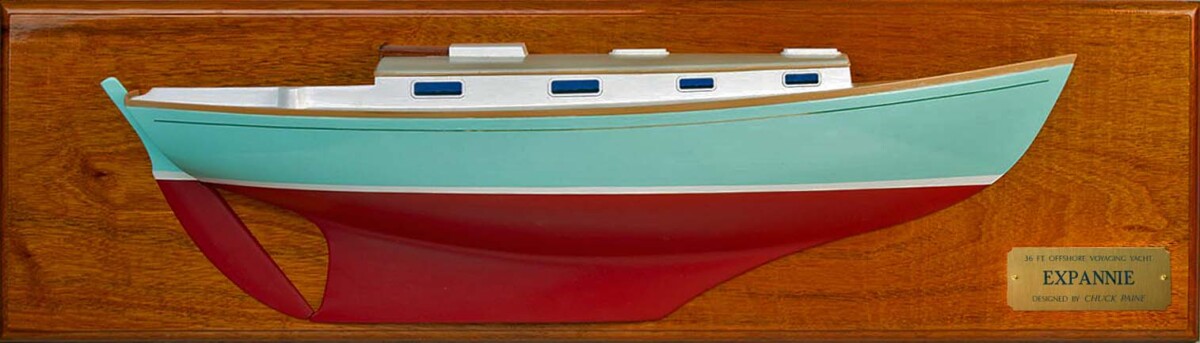
The drawings for EXPANNIE are about one-half completed and an elaborate model carved. Please contact me at; paineyot@aol.com if you would like to build this yacht… I would complete all of the remaining drawings at a very reasonable price when compared with design firms of equal stature.
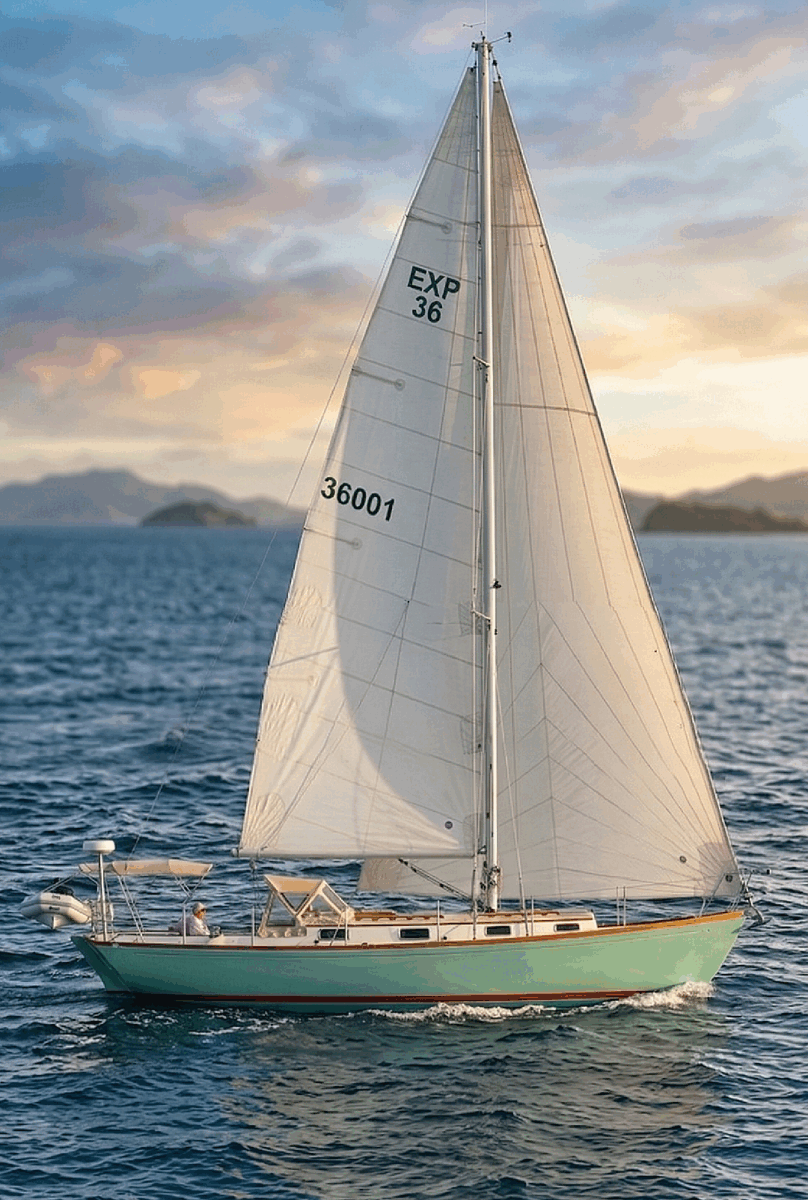
AI Generated image by Jody Culbert.
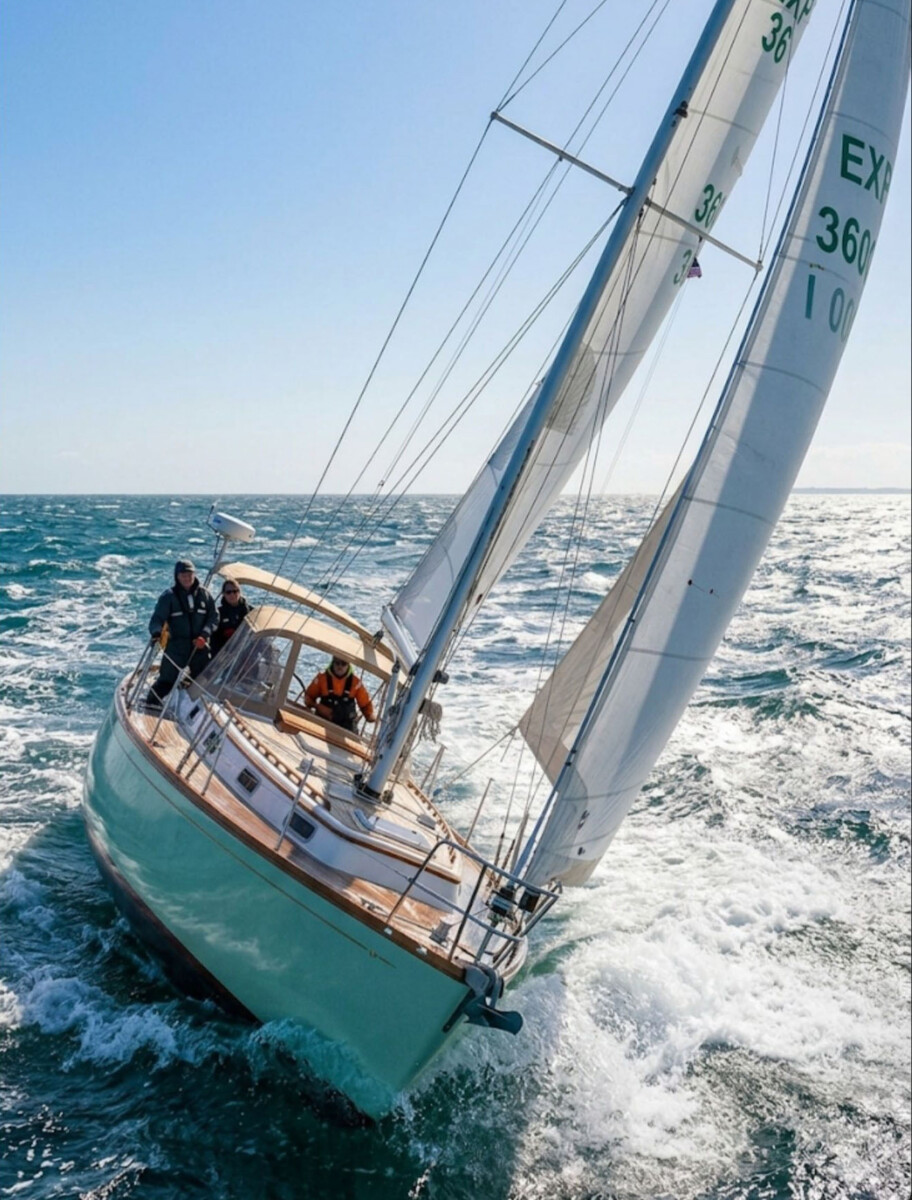
Get out your checkbook and use this beauty to SEE THE WORLD! (AI generated image) Credit: Steve Avery
 Please feel free to contact me at paineyot@aol.com if you have any questions.
Chuck Paine
PS: I got an email from one of the folks at Lyman-Morse boatbuilding who was corresponding with a potential customer who might build an Expannie and needed some guidance to help him answer the most important question any customer will ask… How much will this yacht cost? This particular customer preferred composite glass construction over epoxy cold molded (the yacht could be built using either material). I thought it would be instructive to people who are interested in the process of building a custom yacht to copy my response letter here, so here it is for your enlightenment.
Dear Sir,
Most of the drawings that have been done so far for the design are attached. I began this design years ago when my office was still functioning. It was intended to be a yacht that I might have built for myself. It is still in many ways based on that intention- any customers who might come along and want to build the yacht are responding to my personal philosophies for an offshore, live-aboard yacht. So they might decide to change much of the design to reflect their own tastes, not mine, and I realize my role would be to comply with their, not my own, wishes. At least the overall dimensions of the design will not change- as so much of the design work is done that it would be impractical to “make it a foot longer” or the like.
So, please accept some ramblings about the design, which describe “Chuck Paine’s ideal retirement cruiser”, not what you might ultimately build for someone else.
- If built in glass composite, with a cored composite skin, I would design the hull skins not just to comply with ABS or some other code, but much thicker and heavier, for longevity. So the hull would likely end up as heavy, or heavier, (and thus more costly), than a single skin fiberglass hull.
- The walk-through transom, with a flip-down, gasketed access panel, would be a significant cost raiser. It compromises the structural integrity of the transom, so the other half of the transom will have to be built very robustly, especially since it supports the rudder.
- The replacement of plumbing and seacocks (which inevitably end up difficult to access) for draining the cockpit, by freeing ports and fiberglass trunks with no seacocks, might be a significant cost raiser.
- The swept-back double spreader rig with one aft lower, not double lowers, puts a significant stress on the rigging and chainplates. Being a round-the-world type of yacht, the safety factors on the rigging will be higher than would be the case on a “production” yacht design. The chainplate foundations will be overdesigned, relying on the overglassing not the marine plywood bulkheads and doublers for their hell-for-stoutness. The chainplates themselves will be of stainless steel.
- The rudder is very large yet because the vessel is steered with a tiller, it must be reasonably light (to reduce the inertial forces). Thus it might well be designed with an epoxy/carbon skin. It will require custom cast bronze pintles and gudgeons, and a custom bearing at the bottom that will be quite substantial, heavy, and costly.
- The yacht’s halfload displacement is approximately 18170 pounds. The outside cast lead ballast ingot will weigh approximately 7000 pounds. The keelbols will be of American or UK made bronze, not stainless.
- The interior panels will be of highest quality marine mahogany plywood. Most of them will be ½”. The main bulkhead and chainplate gussets and a few other large panels will be of 5/8” thickness (or closest mm thickness).
- ALL panels that meet the hull side or underside of the deck are to be double-glass bonded.
- The interior theme will be off-white painted plywood panels with varnished mahogany trim. The trim will be more extensive than just “Herreshoff style”, with attractive handgrip corners where appropriate. The inside faces of the house sides, front and back will be of varnished mahogany cladding, there will be varnished mahogany cornerposts, and a few other panels will be also, such that the visual effect of the interior will be approximately 60% off-white painted, 40% select Honduras mahogany, varnished to the nines.
- The portlights will be opening, with insect screens.
- The overhead will be of white panels (Formica clad?), held in place with varnished mahogany battens.
- The engine box will be quickly removable using anti-rattle latches, as will the ladder affixed to it. It will be soundproofed, and the weight of the soundproofing must be balanced against the size of each part of the box. I’ll leave its design to you guys… it will probably benefit from being mocked-up. The idea is that when the ladder and various engine box parts are removed, two things: The engine will be just sitting there out in the open, with all but its port side open for easy servicing. And, the parts of the box will be small enough that they can be moved around in the yacht’s interior and find someplace to live.
- The cabin sole will be teak-and-holly vinyl over epoxy-sealed marine plywood.. There will be removable “floorboards” so that the entire bilge can be accessed.
- The anchor windlass will be electric with manual backup. (This is a Chuck-Paineism and might change given a realistic customer). Finding one that is new and that will work on a vessel of this size might present a challenge.
- The exterior brightwork that you see on the drawings and renderings is not actually of varnished hardwood. It is fashioned to mimic the latter, but in almost all cases is of an appropriate wood (Doug Fir?), epoxy resin soaked and Awlripped a wood color. This includes the tapered, flared toerails and cabin halfround “eyebrows” and cabintop handgrips. This might be a significant cost-reducer versus the more common varnished teak. The parts of the companionway that are visible from the cockpit and the hatchboards and the hatch slider itself will be of highest quality selected varnished Honduras mahogany.
- The deck surface will be Awlgripped over the fiberglass substrate, the Awlgrip flattened and with a nonskid grit. The flattened nonskid will have non-flattened (shiny) and non- nonskidded borders around the perimeter where appropriate. All vertical or near vertical surfaces will be Awlgripped white.
- There will be an elaborate stainless steel combined Kato dinghy davits and Bimini top structure over the cockpit. I would never consider designing this myself. There is a company in Annapolis (Kato) that specializes in stainless steel work and will have done this sort of thing before. It also incorporates a fabric clad backrest for the helmsman port and starboard. It might also accommodate a post for a radar, maybe solar panels on its top, and even might incorporate part of a windvane self-steerer. I lack the skills to design such a thing but you guys can probably find a way to design something that will work and look something like what I have drawn.
That’s what I can come up with as a starting point. I am always available at 691-5195 to answer any further questions. It would be fun for me to once again work with Lyman-Morse on another significant, highest quality yacht.
Note: I also intend to draw plans for WEST epoxy cold molded construction.